



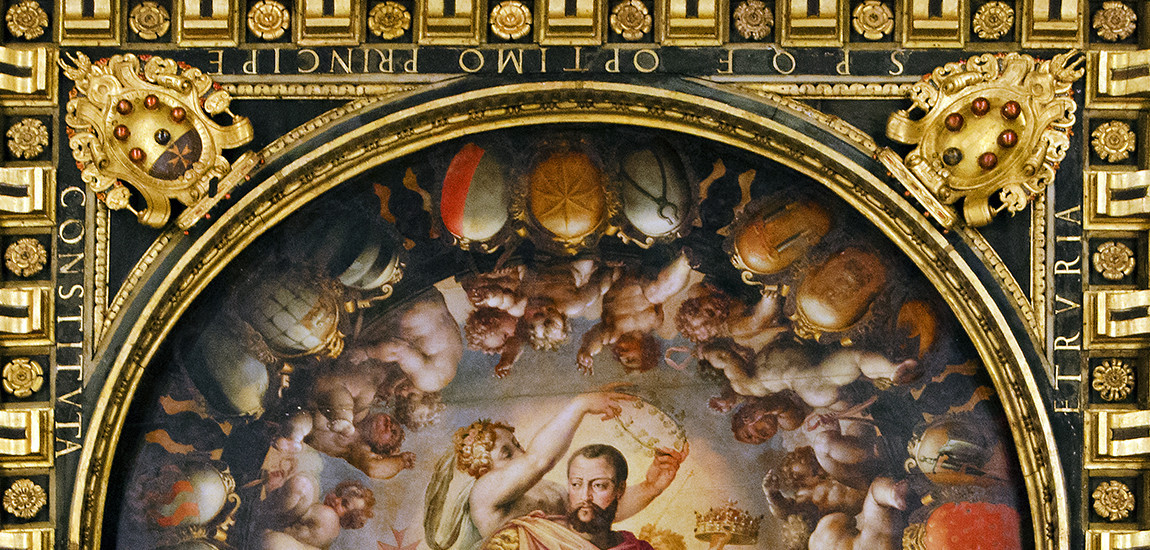
The mistery of the Medici coat of arms
A golden shield with five red balls, and
a blue one decorated with three golden lilies. You must have seen it everywhere
in Florence, since it is the Medici coat of arms.
The Medici blazon underwent inexplicable changes during
most of the fifteenth century, in particular in regards to the number and
assignment of the Medici spheres, finding its near definitive structure during
the reign of Lorenzo the Magnificent.
At the beginning the "balls" in the emblem were eleven, they became nine with Giovanni di Bicci, then eight with Cosimo il Vecchio, Pater Patriae. His son Piero the Gouty reduced again the number to seven, one of which became blue with the three golden lilies of the kings of France, a privilege granted by King Louis XI in 1465. Eventually the final number of six was reached with Lorenzo the Magnificent. The reason for these numbers remains quite a mystery.
Even the meaning of this coat of arms,
symbol of one of the most influential families in Italy, is not clear, and
there are many theories in regards.
The less imaginative of us like to think that the
balls of the coat of arms (bezants), are nothing more than the representation
of the protruding studs that fixed the attacks of the shield's embrace, a very
sensible hypothesis in fact, which would also explain the recurrence of the bezants
in the coats of arms of Tuscan families.
Others think that these spheres on the Medici blazon refer to the origin of the family, which in ancient times was part of the Arte dei Medici e Speziali (Physicians and pharmacists). So the red bezants would represent the pills that pharmacists prepared in their workshops, generally red in color to distinguish them from other products.
Another hypothesis, the less credible one but
certainly fascinating, is that the Medici coat of arms design originates from a
legend.
It is said that a giant named Mugello lived in Val
di Sieve and that the leader of the house, Averardo de Medici, faced him in a
duel. According to this story, therefore, the bezants of the Medici coat of
arms would be the marks left by the toothed mace of the giant Mugello on
Averardo's shield.
Darker, is the story that sees Averardo de Medici,
who had been a soldier following Charlemagne’s army, as a bloodthirsty
protagonist: according to this version, the Medici balls would represent the
severed heads of Averardo's enemies.
A little more likely, is the theory according to which the bezants of the coat of arms represent oranges, like those that grew in the garden of the Hesperides, and a fruit grown in all the gardens of the Medici villas. These fruits would also be a reference to the Medici family's trade with the East.
Finally, the most accredited theory maintains that the coat of arms originates from that of one of the seven major Arts of the Florentine guilds, the Arte del Cambio (bankers and money-changers), which also included the Medici family.
The guild’s blazon was red with gold bezants, to represent the coins. So whoever originally conceived the Medici coat of arms would simply have inverted the colors.
In short, the origin of the Medici coat of arms remains mostly shrouded in mystery.
But, however uncertain its meaning, there is no doubting the ardor that this symbol unleashed in the hearts of the Florentines: after the the conspiracy plotted by the Pazzi on April 26, 1478, seeing Lorenzo and his followers return safely, the Florentine people gathered in Piazza Signoria acclaimed them at the cry of "Palle! Palle!" (“Balls! Balls!”, inspired precisely by the Medici coat of arms) and unleashed their ferocity on the traitors of the beloved Florentine family.