



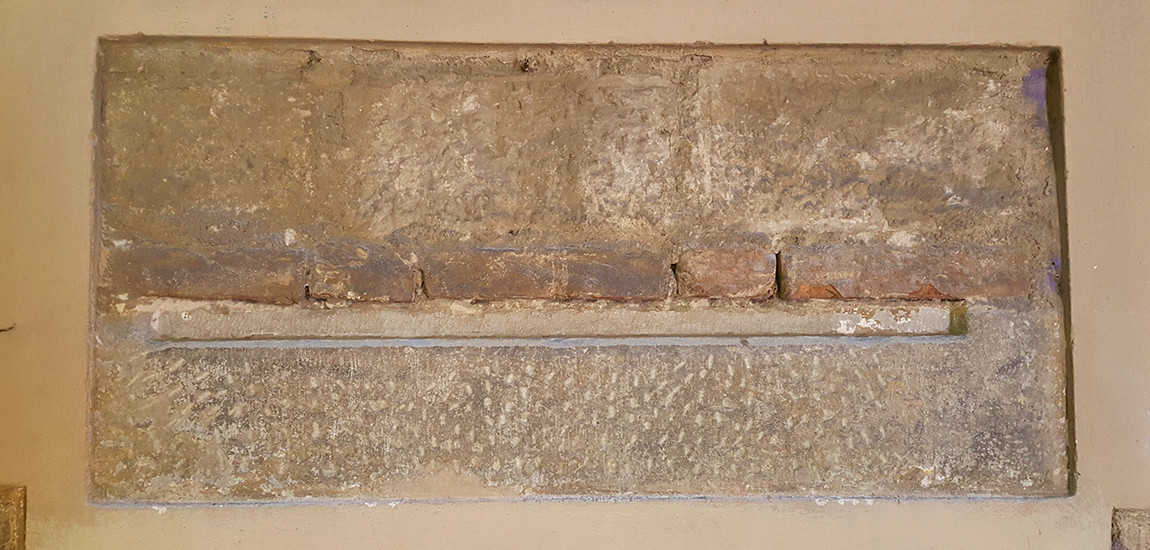
Florentine curiosities: traces of ancient units of measurement
The tape measure is an object that we all have at home, a tool of little importance, often forgotten at the bottom of a drawer under the batteries and
the rolls of adhesive tape. We would never consider it a luxury item.
But
what if we told you that in order to take the measurement of a fabric you had
to leave the house and go to Via de’ Cerchi or Piazza del Duomo? You would then
do anything to have your own little tape measure handy! It might seem a somewhat
far-fetched example, but it is not too far from the reality of the past.
Before
the decimal metric system was introduced, all cities in Italy, including
Florence, had their own measurement system. This created many problems as the unit for measurement changed from region to region and even from city to city. That
is why at some point, in the 19th century, a standardized metric decimal system was created.
Up until that moment, taking measurements was a quite complicated affair.
In
Florence, the official unit of measurement was the braccio fiorentino (Florentine arm),
Florentine arm (58.36 cm), so called because it measured like the arm of an
adult man.
The
Florentine merchants were cunning men and often had the apprentices measure fabrics, being them 12-14 year-olds with naturally shorter arms. Here was a
big problem for the buyers: how could you make sure the fabric that you had
been sold measured the correct length?
Well, you had to go to Via de’ Cerchi,
near Piazza della Signoria, and take the measurement directly from a metal rod
built into the wall at arm height, reporting the official measurement of a
Florentine arm.
At
that time being ripped-off was frequent and it was precisely from this
habit of the merchants that came the saying "avere le braccia corte" (to have short arms).
Another
place where the "correct" measurements could be taken was in Piazza San
Giovanni, where the measure of the Florentine arm was carved on a column of the
Baptistery.
Here
you could also find the unit of measurement that was previously in use, since
the early Middle Ages: il piede di Liutprando (Liutprando's foot).
Liutprando
was an apparently very tall Lombard king, with such large feet that
they ended up being adopted as a unit of measurement.
When
the Florentine arm became the new official unit of measurement, a rectangle
with its measure was carved next to that of Liutprando's foot, on the columns
of the south entrance of the Baptistery.
These
ancient measuring tools can still be found in the same places
today, but people pass by them each day, unaware of their meaning.
By now you should know, that in Florence even anonymous grooves in the wall
could prove to be evidence of historical relevance!