



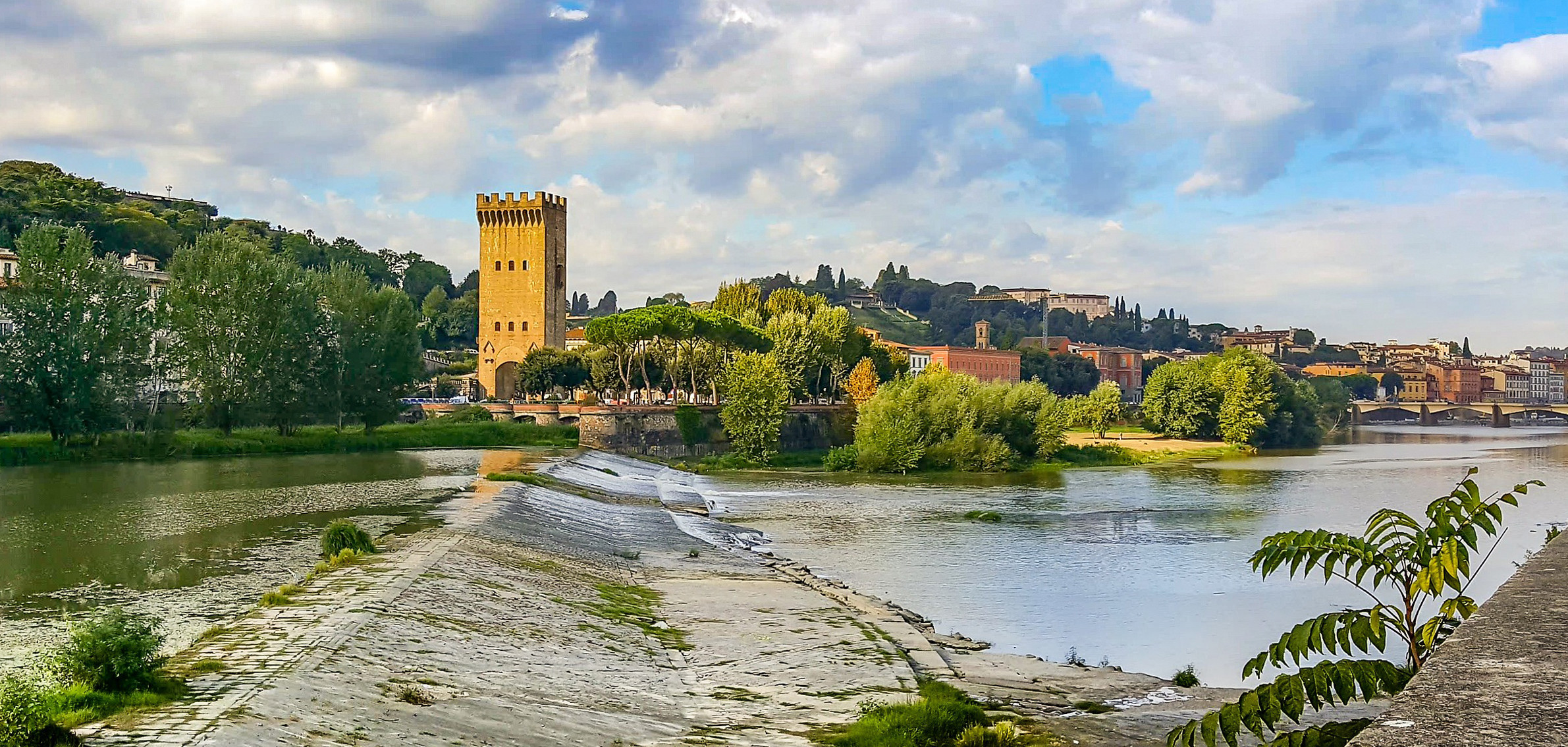
The towers of Florence
With the arrival of summer it will be possible to access the Torre di San Niccolò, Torre della Zecca and Porta Romana, usually closed to the public, and now opening their doors to visitors on selected days.
The Torre di San Niccolò already reopened, as usual, on the occasion of the celebrations of Saint John's Day on June 24, to allow visitors to watch the firework show from a vantage point of view over Florence.
Built around 1345 and the only one to maintain its original height, this tower offers breathtaking views over the city, the river Arno and the surrounding hills.
This structure was actually one of the big gates leading into the city, integral part of the ancient walls that once encircled and protected Florence, built following a design by Arnolfo di Cambio.
The ambitious project provided Florence with a 8 kilometers long wall circuit interrupted by fifteen big gates and various defensive towers. The construction works lasted almost fifty years, from 1284 to 1333.
The walls and some of the towers were destroyed in the 19th century to actualize the project of urban renewal by Giuseppe Poggi, but the Torre di San Niccolò was spared, and with its 115 feet of height and 160 steps leading to the top is now one of the highest panoramic viewing points over the river.
This summer the tower will remain open every day until August 31, with guided tours every half-hour.
The Torre della Zecca Vecchia along with its twin, the Torre di San Niccolò on the other side of the river and the kiddle between them that prevented the passage of boats, were an essential part of the city’s defenses. In addition to this, a secret passage, now flooded and unaccessible, run inside the kiddle connecting the two riverbanks of the Arno.
The tower got its name from the coin minting production (zecca) that for a period was housed here, using the force of the water that flowed beneath it to activate the machines used for the producton of coins.
Its relationship with the water was so important that on one of the sides of the tower there is a marble plaque in wich are carved some verses of the Divina Commedia by Dante Alighieri dedicated to the river Arno.
The tower underwent a restoration and only reopened to the public in the summer of 2016, after 15 years of closure. It is now possible to access it with guided tours that take place once a month from 15 July to 14 October.
Porta Romana, placed right on the path leading to Rome, is the southernmost of the gates of the city and one of the few remaining stretches of the ancient walls.
Once named Porta San Pier Gattolino after the church that had stood at the site since at least 1068 and that was destroyed when Cosimo I enhanced the walls around Florence, the structure was built between the 1328 and the 1331 following a design by Andrea Orcagna. It's one of the biggest gates of the city along with Porta San Frediano.
The structure was lowered in the XVI century, like all the other towers of Florence with the exception of the Torre di San Niccolò, to avoid cannon bombing.
A road that starts near the gate and runs along the lenght of the Boboli Gardens, allowed the inhabitants of the Pitti Palace to exit and enter Florence without having to navigate the city streets.
Visitors can now walk along the walkway to the roof enjoying a spectacular view of the Boboly Gardens.
Also, for the first time, this summer will be possible to visit the Baluardo a San Giorgio, a fortification built in 1544 on the commission of Cosimo I to enhance the city’s defence system during the siege of Florence in 1529-30.
The trapezoidal structure set on one of the ramparts erected by Michelangelo Buonarroti, is today home to the Compagnia Balestrieri Fiorentini (Florence’s crossbow society).
The baluardo, located in the area between the Rose Garden and the Bardini Garden, will be open to visitors once a month.
When in Florence this summer, get away from the museums and the crowded streets for a while and take this chance to see the city from a different point of view!
Reservations are necessary for the guided tours: email info@muse.comune.fi.