



Looking for the unnoticed: Palazzo Pitti
Palazzo Pitti is certainly the largest palace in Florence, now home to priceless treasures, once home to the lords of the city, the Medici. We all know it as the residence of the Medici family, in fact, but its name reveals its true origins.
Luca Pitti, the archenemy of Cosimo de Medici, had it built in 1441 by architect Luca Fancelli, testifying to the economic power achieved by the merchant family.
A power that was lost precisely because of this great rivalry with the Medici. Following the failed attack against Piero de Medici in 1460, in fact, the Pitti fell into disgrace and the construction of the palace was interrupted in 1465.
Ironically, a hundred years later it was the Medici who bought Palazzo Pitti, from the then owner, Buonaccorso Pitti.
Cosimo was, in fact, looking for a new home for his lady, Eleonora di Toledo, who fancied to get away from the unhealthy air of the city to get closer to greener areas and leave what consequently to the transfer became the "Palazzo Vecchio". So the new palazzo underwent an expansion between 1558 and 1570, but some curious elements remained unaltered. There are many stories related to this building, but what we want to focus on today, are two little curiosities concerning these elements related to its construction.
As we said, Luca Pitti invested a lot of time and money in this grand palace, which could have contained the entire palazzo della Signoria; but he was not the only one who put all his energies into it.
The construction of the building required much effort from everyone, including animals.
Entering the inner courtyard, in the left corner, you will find a curious marble bas-relief representing a donkey. The inscription above it says:
LECTICAM LAPIDES ET MARMORA LIGNA COLUMNAS
VEXIT CONDUXIT TRAXIT ET ISTA TULIT
"With its cart, with sacrifice, it pulled, transported stones, marbles, timber, columns."
One of the rare monuments that have been dedicated to animals by the Florentine, homage to a donkey who contributed until his death to the construction of the building; an aid, such that at the end of the works Luca Pitti decided to pay homage to it with this bas-relief.
Another small curiosity about the building is aroused by elements on its façade.
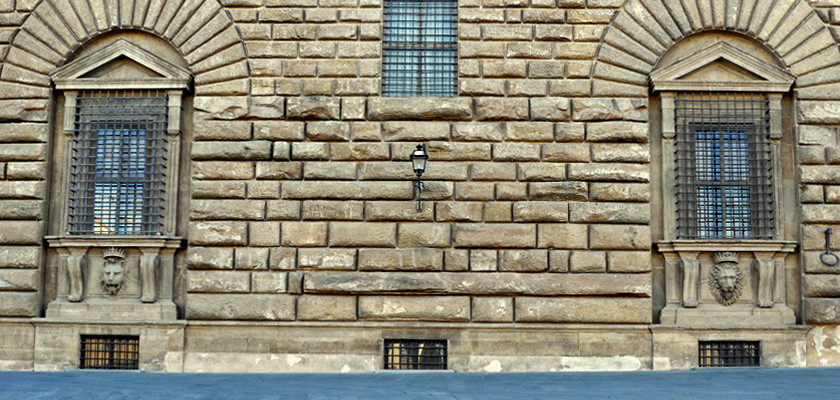
Apparently similar to that of many other Florentine noble palaces, the façade is decorated with the characteristic “bugnato”, a very popular masonry work in Italy during the Renaissance, which involves the use of protruding, irregular and rough stones that are reduced in thickness as height increases. But between these stones there are two, a bit 'special ones: two blocks of unusual size, completely different from each other; one very long, 12 meters, and the other very short, not even reaching 50 cm in lenght.
It seems that Luca Pitti wanted to insert those two stones as a sneer to his rivals. He, head of the Pitti family, identified himself with the bigger and heavier stone, while the small one represented his rivals (perhaps the Medici or the Strozzi), in his eye, envious of his fortune and his success which had allowed him to build a princely palace such as that.
So next time you go visit the Pitti Palace, do not hurry inside right away, but linger for a while outside and in the courtyard to look for the “sneering” stones and the plaque dedicated to the donkey. It is often the littlest, overlooked details that add some color to the story of a place.